Tag: AI Readiness

  • Data Governance Framework: Components, Models, and Examples

    Data Governance Framework: Components, Models, and Examples

    Most companies do not have a data problem. They have an ownership problem. Reports disagree, nobody knows who can approve access to a customer table, and every AI pilot stalls when someone asks where the training data came from. A data governance framework is what fixes that.

    In short, a data governance framework is a documented system of roles, policies, processes, and standards that defines how your organization collects, stores, secures, and uses data. It answers four questions: who owns the data, who can use it, what rules apply, and how you prove it. Most frameworks, including DAMA-DMBOK and the DGI model, are built from the same handful of parts.

    Below, you will find the core components of a framework, a side-by-side look at the major models, and practical examples you can adapt. We also cover how to build one step by step. Our team has put these frameworks into production for enterprise and regulated clients, so the guidance comes from delivery work, not theory.

    Why a data governance framework matters

    Without governance, every team defines data on its own. Sales counts a customer as a signed contract, finance counts an invoiced account, and support counts anyone with a ticket. None of them is wrong, but together they are unreliable. A framework gives the business one set of definitions, owners, and rules, so those arguments end before the quarterly report.

    The cost of ungoverned data

    Bad data is expensive in ways that rarely show up on one line item. Analysts spend days reconciling spreadsheets instead of analyzing them. Marketing emails the same person three times. Operations ships to stale addresses. Duplicate and inconsistent records drain hours every week, and decisions built on the wrong number are harder to catch than the hours lost.

    Ownership is the root cause. When nobody is accountable for a dataset, nobody fixes it. A good framework for data governance names an owner and a steward for each critical domain, so a quality issue has an address. In our delivery work, this one change resolves more problems than any tool purchase.

    Regulation and AI raise the stakes

    Rules on data keep tightening, and regulators expect evidence, not good intentions. A data privacy governance framework lets you show where personal data lives, why you hold it, and who has touched it. The table shows what common regulations ask of your data practices.

    Regulation What it expects from your data practices
    GDPR Lawful basis for processing, records of processing, data subject rights
    CCPA/CPRA Right to know, delete, and opt out of sale or sharing
    HIPAA Safeguards for protected health information, minimum necessary access
    GLBA Protection of customer financial information
    EU AI Act Documented data governance for training data in high-risk AI systems

    AI adds a second layer of risk. Models inherit every flaw in their training data, so a biased or stale dataset becomes a biased or stale decision. If you cannot trace data lineage and consent, you cannot explain an output to an auditor or a customer. AI governance starts with data governance, which is why stalled AI pilots so often trace back to missing ownership.

    What you gain in practice

    Teams that put a framework in place usually see the same gains, and most appear within the first two quarters:

    • Trusted numbers: one definition of each key metric, so reports match.
    • Faster access: clear approval paths replace weeks of email chains.
    • Lower risk: audit trails, retention rules, and access controls you can show on request.
    • Cheaper operations: fewer manual fixes, less duplicate storage, less rework.
    • AI readiness: documented, quality-checked data that models can safely use.

    A framework does not slow data use down. It makes data safe enough to use at speed.

    Scale is where the payoff grows. A startup can survive on tribal knowledge, but an enterprise data governance framework has to hold across dozens of systems, several regions, and thousands of users. Skipping it early does not save time. It just moves the cleanup to a moment when more data, more teams, and more regulators are involved.

    Core components and pillars of a framework

    Labels vary between models, but the data governance framework components are nearly the same everywhere. Think of them as six pillars. If one is missing, the others carry extra weight until something cracks.

    The six pillars at a glance

    Pillar What it covers Typical artifact
    People and roles Owners, stewards, governance council RACI chart
    Policies and standards Usage, retention, naming, definitions Data policy
    Processes Access requests, issue escalation, change control Workflow
    Data quality Accuracy, completeness, timeliness Quality scorecard
    Security and privacy Classification, access, consent Classification scheme
    Metadata and lineage Glossary, catalog, traceability Data catalog

    Most failed programs over-invest in one row, usually tooling, and ignore the people row. Fix that imbalance first.

    People come first

    Start with roles and accountability. A governance council of five to eight senior leaders sets priorities and settles disputes. Data owners are accountable for a domain such as customer, product, or finance. Stewards do the daily work: fixing records, maintaining definitions, and answering questions from analysts.

    Overhead view of a round table with name cards at each seat and a folder with a key in the middle.

    A policy nobody owns is a document, not governance.

    Write each role down with its decision rights. If two people think they approve access to the same table, you have recreated the original problem with better titles.

    Policies, quality, and metadata

    Policies turn intent into rules people can follow. Cover classification, retention, access, and acceptable use, and keep each one to a page or two. Long policies do not get read, and unread policies do not get enforced.

    Quality only works when it is measurable. Set thresholds such as "98% of customer records have a valid email" and publish a scorecard each month. Pair that with a business glossary and a catalog, so everyone can see what a field means, where it came from, and who to ask about it.

    Security and privacy complete the set. Classify data by sensitivity, tie access to role, and log who touched what. These controls are also the evidence an auditor will ask for first.

    Popular data governance frameworks compared

    No single model wins every time. The major frameworks overlap heavily, so the real question is which one fits your size, industry, and tolerance for process. If you searched for the DGI data governance framework or DAMA-DMBOK, this comparison shows where each one earns its place.

    Side-by-side comparison

    The table below lines up the four models we see most often in enterprise work. Use it to narrow the field to one or two candidates before you read the source material.

    Framework Origin Best for Main strength Main drawback
    DAMA-DMBOK DAMA International Large, mature data teams Complete vocabulary across 11 knowledge areas Dense, and too heavy to adopt whole
    DGI Framework Data Governance Institute Organizations starting out Simple structure that executives grasp quickly Light on technical detail
    DCAM EDM Council Banks and financial services Capability scoring you can show regulators Built around financial sector needs
    COBIT ISACA IT-led, audit-driven companies Strong controls and audit alignment Treats data as part of IT governance

    DAMA-DMBOK and DGI in practice

    DAMA-DMBOK is a reference book, not a recipe. It places data governance at the center of a wheel of 11 knowledge areas, including quality, security, and metadata. Treat it as a shared vocabulary and a gap checklist. Trying to implement every chapter is how a ten-person team stalls for a year.

    The DGI framework works better as a starting blueprint. It organizes ten components into three groups: rules, people, and processes. That maps cleanly to the six pillars covered earlier, and it is easy to draw on one slide for a steering committee. Its weakness is technical depth, so you will fill in quality and metadata details yourself.

    How to choose

    Match the model to your constraints, not to its reputation. A bank under supervisory review will lean toward DCAM because examiners recognize it. A mid-sized retailer with no data office will get further with DGI. In our experience, most clients end up with a hybrid: DGI’s structure for the operating model and DAMA’s definitions for the vocabulary, plus whatever regulatory controls their industry demands.

    Pick the model that fits your regulators and your culture, then borrow from the rest.

    How to create a data governance framework

    Building a framework is less about writing documents and more about getting decisions made. If you want to know how to create a data governance framework that people actually follow, start with one business problem and expand only after it works. The sequence below is the one we use with clients.

    Seven steps from kickoff to operation

    Each step produces a concrete output, which keeps the project from drifting into endless workshops.
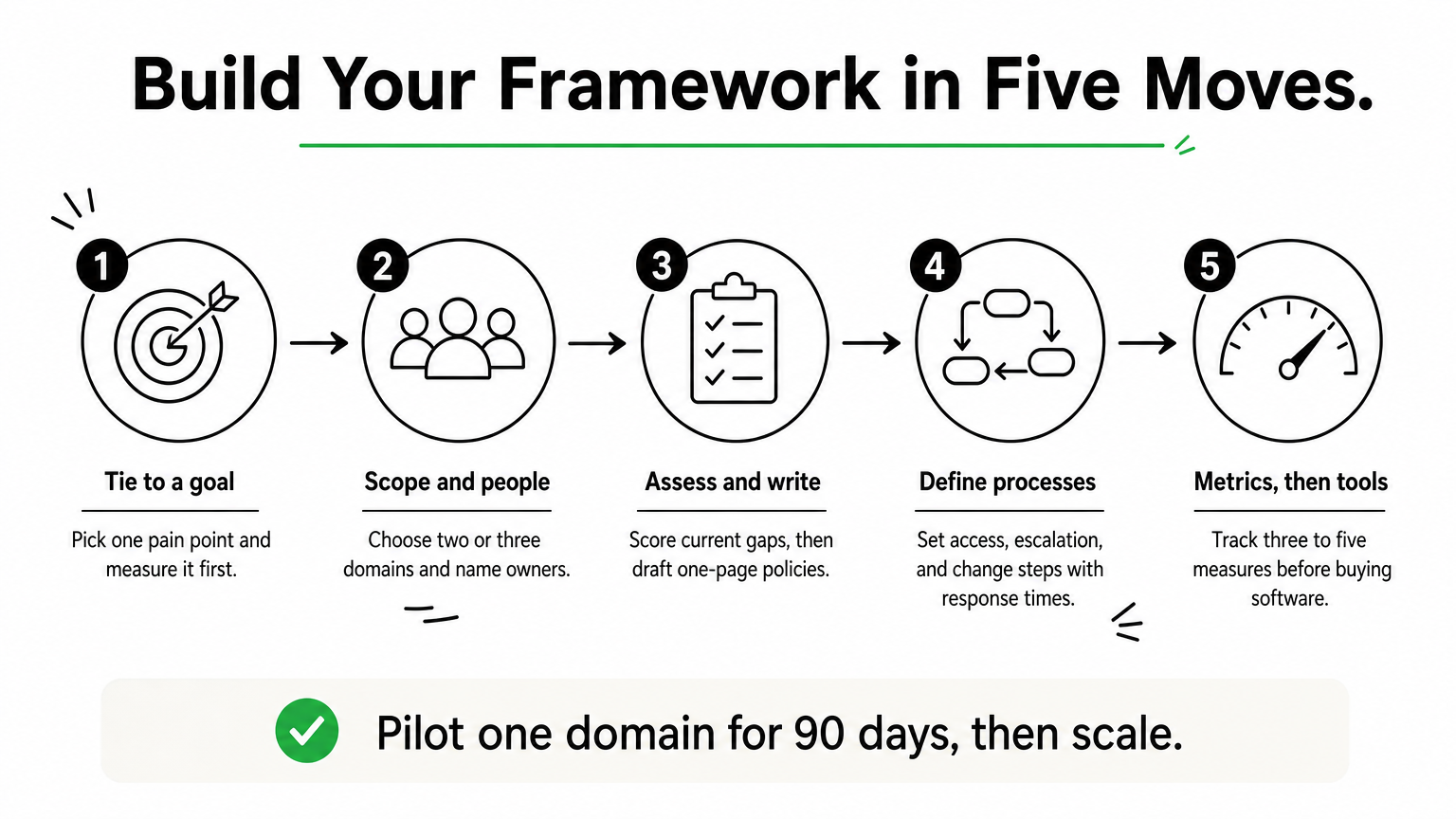
    Process infographic showing five moves for building a data governance framework, from goal to metrics and tools.

    1. Tie it to a business goal. Pick one pain point, such as conflicting revenue reports or an audit finding, and measure it before you begin.
    2. Set the scope. Choose two or three critical domains, such as customer and product. Leave the rest for later.
    3. Name the people. Appoint a council, an owner per domain, and stewards. Use names, not departments.
    4. Assess the current state. List the systems that hold critical data, then score quality, access, and documentation gaps against your chosen model.
    5. Write minimum viable policies. Cover classification, access, quality thresholds, and retention in a page or two each.
    6. Define the processes. Set up access requests, issue escalation, and change approval, each with a response time.
    7. Choose metrics, then tools. Track three to five measures, and buy a catalog only after roles are settled.

    Pilot first, then scale

    Run the full cycle on a single domain for about 90 days. Customer data is a common choice because every team touches it. Publish the first quality scorecard by week six and log every council decision, so the pilot leaves an audit trail from day one.

    Start with one domain, one owner, and one measurable problem.

    Once the pilot shows a result, such as a falling duplicate rate or faster access approvals, extend to the next domain and reuse the same roles and templates. Teams that skip the pilot usually produce a polished framework that nobody has tested against real work. Teams that run it get a proven operating model and an internal success story that makes the next rollout easier to fund.

    Data governance framework template and diagram

    Documents beat discussion only when they are short. A data governance framework template should fit on one page, and a data governance framework diagram should fit on one slide. If either runs longer, people stop reading it.

    A one-page template you can copy

    Copy the outline below into a shared document and fill in every blank. It mirrors the seven build steps, so each answer comes from work you have already done.

    DATA GOVERNANCE FRAMEWORK: [Company name]
    1. Business goal: [problem] | baseline: [x] | target: [y]
    2. Scope: [domains] | [systems] | [regions]
    3. Roles
       Council chair: [name]
       Data owner, [domain]: [name]
       Data steward, [domain]: [name]
    4. Policies: classification, access, retention, quality, acceptable use
    5. Processes: access request (response time: [x] days),
       issue escalation, change approval
    6. Quality thresholds: [field] at or above [x]%
    7. Metrics: [3 to 5 measures]
    8. Review: council monthly, framework annually
    

    Blanks matter more than prose. A field that says "TBD" next to an owner means nobody is accountable yet, and the template is only a wish list.

    A template works only when every blank holds a name or a number.

    A diagram executives can read in a minute

    Next, draw the structure as layers of accountability. Keep it to one slide, with decision rights flowing down and issues flowing up.

    [ Governance council: priorities, disputes ]
                      |
    [ Data owners: one per domain ]
                      |
    [ Data stewards: quality, definitions ]
                      |
    [ Policies | Processes | Standards ]
                      |
    [ Customer data | Product data | Finance data ]
    

    Read it top to bottom. Each layer answers to the one above it, and every box has a named person, not a department. Add tools such as your catalog only at the bottom, so nobody mistakes software for the framework itself.

    Framework examples for enterprise, big data, and privacy

    The six pillars stay the same across organizations. What changes is where you put the weight. These data governance framework examples are composites drawn from our client work, so you can see how the structure bends under different pressures.

    Enterprise: a federated model for a multi-region insurer

    Large organizations rarely succeed with a fully central team. A federated model works better: a small central office sets policy, and each business domain owns its data. At a typical insurer, the chief data officer chairs the council, with owners for claims, policy, and billing, and stewards embedded in each line of business.

    • Central office (4 to 6 people): standards, tooling, and monthly scorecards.
    • Domain owners: approve access and accept quality targets.
    • Regional leads: adapt policies to local law.

    In an enterprise, centralize the rules and decentralize the accountability.

    Big data: govern at the point of ingestion

    A big data governance framework cannot rely on manual review. Volume and speed are too high, so controls move into the pipeline. Tag and classify data when it lands, and apply stricter rules as it moves toward the zones people actually use. This zone model is common in data lakes.

    Three connected tanks of increasing height joined by pipes with checkpoint gates and tags.

    Zone Governance applied
    Raw Source logged, sensitive fields auto-tagged, restricted access
    Curated Quality checks, schema validation, lineage captured
    Trusted Certified definitions, named owner, broad access

    Privacy: built around personal data

    A privacy-led framework starts with an inventory of personal data: what you hold, why, where it sits, and the lawful basis for using it. Add consent records and retention schedules to that inventory, and assign a privacy officer as the owner.

    Requests then become a process with a clock. GDPR gives you one month to answer an access request, and CCPA gives you 45 days. Build the request workflow and deadline tracking once, and every regulation you add later reuses it.

    Choosing software to support your framework

    Software should serve the framework, not define it. Data governance framework software automates work your roles and policies already describe, which is why tool selection comes last in the build steps. If you buy before owners are named, you end up with an expensive catalog nobody maintains.

    What the main tool types do

    Most products fall into five categories. Each one supports a specific pillar from earlier.

    Tool type Job it does Pillar supported
    Data catalog and glossary Search, definitions, ownership Metadata and lineage
    Data quality tools Profiling, rules, monitoring, scorecards Data quality
    Privacy and access management Classification, consent, request tracking Security and privacy
    Lineage and observability Trace data flows, alert on pipeline breaks Metadata and lineage
    Workflow and policy management Approvals, attestations, audit trail Processes

    Platforms such as Microsoft Purview bundle several categories, which cuts integration work. Specialist tools go deeper on one job. A specialist makes sense when a single pillar, often quality, is your biggest gap.

    Questions to ask before you buy

    Score every vendor against the same checklist, and ask for answers on your own data, not a polished demo.

    • Does it connect to your warehouse, CRM, ERP, and cloud storage without custom code?
    • Can stewards use it without help from engineering?
    • Does it capture lineage automatically, or only when someone documents it?
    • Can it enforce policies, or does it only record them?
    • What is the full cost at rollout, including licenses, integration, and training?

    Mistakes that waste the budget

    Test before you commit. Run a proof of concept on your pilot domain for 30 days and measure it against the baseline from step one. A tool that cannot move that number will not move it at scale either.

    Buy software to enforce decisions you have already made, not to make them for you.

    Finally, watch for lock-in and scope creep. Pick tools that export your metadata in open formats, so a vendor change does not erase years of glossary work. Roll features out one domain at a time, and keep the owners from your template in charge of every configuration choice.

    Putting your framework to work

    A data governance framework works when everyone can see who owns what. The six pillars, the model comparison, the template, and the tooling checklist all serve that goal. Name the owners first, write short policies people will read, and let software enforce decisions you have already made.

    Start small. Pick one domain, run it for 90 days, and measure the result against your baseline. A proven pilot beats a polished document, and it gives you the evidence to expand into the next domain with the same roles and templates.

    If you want a senior team to design the roles, policies, and tooling, or to connect governance to your AI roadmap, talk to the engineers behind our data governance and BI services at Hatzs Dimensions. We will help you build a framework your teams actually use.
  • AI Agents vs Agentic AI: What Each Is and How They Differ

    AI Agents vs Agentic AI: What Each Is and How They Differ

    People use the terms interchangeably, and that causes real problems when you scope a project or evaluate a vendor. If you are comparing AI agents vs agentic AI, the short version is this: they are not the same thing, and mixing them up leads to mismatched budgets and expectations.

    An AI agent is a single software component built to complete a defined task, such as answering support tickets or pulling data from a CRM. Agentic AI is the broader approach, where one or more agents plan, decide, and act toward a goal with minimal human direction. Think of agents as the workers and agentic AI as the system that coordinates them. Both differ from generative AI, which creates content when prompted but does not act on its own.

    Below, we define each term, show how they relate, and walk through practical examples. We also explain where generative AI fits. Our senior engineers have shipped enterprise AI systems into production for over 7 years, so the guidance here comes from real deployments, not theory. By the end, you will know which one your use case calls for.

    Why the difference between AI agents and agentic AI matters

    Most teams first hit this distinction in a budget meeting. Someone asks for "an agentic AI solution," engineering hears "a chatbot with a few tools," and finance hears "a platform." The label sets the scope, and a wrong label means a wrong estimate. Settling the agentic AI vs AI agents question early also keeps your project plan honest before any code is written.

    It changes what you scope and budget

    A single AI agent has a narrow job, a short list of tools, and a clear finish line. Think of an agent that classifies inbound support tickets and drafts replies. You can scope it in a short discovery phase and test it against a fixed set of real examples.

    Agentic AI is a different build. You are designing several agents, the logic that hands work between them, shared memory, and rules for when the system must stop and ask a person. The orchestration layer takes most of the effort, not the individual agents. Teams that price an agentic system like a single agent usually run out of budget at integration.

    It changes your risk profile

    An agent that drafts a reply can be wrong in a small, visible way. A system that plans its own steps, calls your billing API, and updates customer records can be wrong in ways that compound before anyone notices. Autonomy raises the cost of every mistake, so the controls you need grow with it.

    The more freedom a system has to act, the more it needs guardrails, logging, and a human checkpoint.

    The table below shows how the same questions get different answers depending on what you are building.

    Question Single AI agent Agentic AI system
    Scope One defined task A goal that spans many tasks
    Main build effort Prompts, tools, evaluation Orchestration, memory, guardrails
    Impact of an error Usually limited to one output Can cascade across steps and systems
    Oversight needed Spot checks and sampling Audit trails and approval gates

    Regulated industries feel this most. In banking, insurance, and healthcare, compliance teams ask what a system is allowed to do on its own. "It’s an agent" does not answer that. They want defined decision boundaries and a clear AI governance record of who approved what.

    It changes how you evaluate vendors

    Vendors use both terms loosely. A product with one model call and a button can end up marketed as "agentic." Four questions cut through the pitch:

    • Does it plan multiple steps on its own, or follow a fixed script?
    • Which systems can it act on, and with what permissions?
    • What happens when it fails or is unsure?
    • Can you see and audit every action it takes?

    Clear answers tell you whether you are buying a capable single agent or a coordinated system. Both can be the right purchase. The problem starts when you pay for one and expect the other.

    How to tell AI agents and agentic AI apart in practice

    Definitions only help if you can apply them to a real system. When you review a demo, an architecture diagram, or your own backlog, run a few simple tests instead of trusting the label. The tests below settle most debates about AI agents vs agentic AI in a few minutes, and they look at behavior, not marketing.

    Four tests you can run on any system

    Each test asks what the system does, not what the vendor calls it. Count how many rows lean right in the table. One is a hint. Three or four means you are dealing with agentic AI.

    Test Leans toward an AI agent Leans toward agentic AI
    Goal A defined task, such as "classify this ticket" An outcome, such as "resolve this customer’s issue"
    Planning Follows a path someone designed Builds and revises its own steps
    Coordination One component does the work Several agents hand work to each other
    Memory Context lasts one session State persists across tasks and days

    Planning is the most telling test. An agent walks a path that an engineer drew. An agentic system chooses its own path, changes it when a step fails, and decides when the goal is met.

    One request, two designs

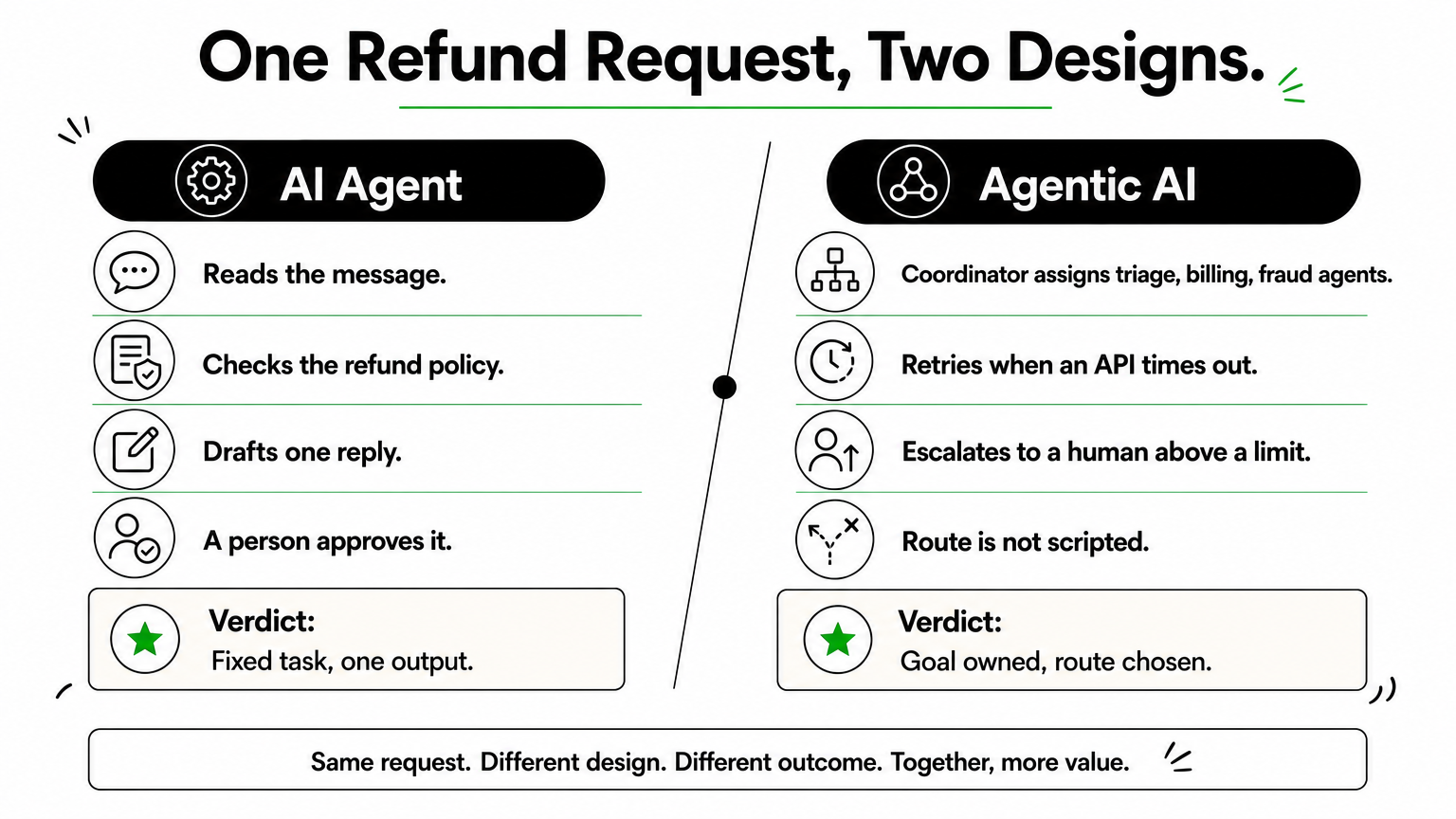
    Consider a customer refund request. Built as an AI agent, the system reads the message, checks the refund policy, and drafts a reply for a person to approve. The task is fixed and the output is one reply.

    Comparison of an AI agent and an agentic AI system handling the same refund request.

    Agentic AI treats the same request as a goal: resolve this refund. A coordinator assigns a triage agent, a billing agent, and a fraud-check agent, retries when an API times out, and escalates to a human when the amount passes a set limit. Nobody scripted the exact order of those steps.

    If one component finishes a named task, it is an agent. If the system chooses the route to an outcome, it is agentic AI.

    Where the line blurs

    Plenty of products sit in the middle. A single agent with a loop and five tools can plan within one task without any coordination. Call it an agent with agentic traits, and ask what it can do without a person. That answer, not the label, should drive your risk review and your budget.

    How generative AI, AI agents, and agentic AI compare

    Three terms get blurred together in most vendor decks, so it helps to place them on one scale. Generative AI creates, an AI agent acts, and agentic AI pursues a goal. Each step up adds capability, and each adds risk.

    Generative AI produces, it does not act

    Generative AI takes a prompt and returns content such as text, code, images, or summaries. Ask it for a refund email and you get a polished draft. It does not send the email, check the refund policy, or notice that the customer has written twice. A person carries every output into the next system, so a human stays in the loop for each step.

    Side-by-side comparison

    The table shows where the three differ on the points that affect cost and oversight.

    Generative AI AI agent Agentic AI
    Core job Create content Complete a defined task Reach a goal across tasks
    Starts when You write a prompt A trigger or request arrives A goal is set
    Acts on systems No Yes, through a few tools Yes, across many systems
    Planning None Follows a designed path Builds and revises its own plan
    Human role Uses every output Approves or samples Sets goals and limits

    Notice that the jump from generative AI to an agent is about access to tools. The jump from an agent to agentic AI is about who decides the route. Those are different engineering problems with different price tags.

    They stack, they do not compete

    Most AI agents run on a generative model. The model reads the request and reasons about it, and the agent wraps that model with instructions, tools, and a task. Agentic AI then coordinates several of those agents. The same model can sit under all three, which is why the labels confuse buyers.

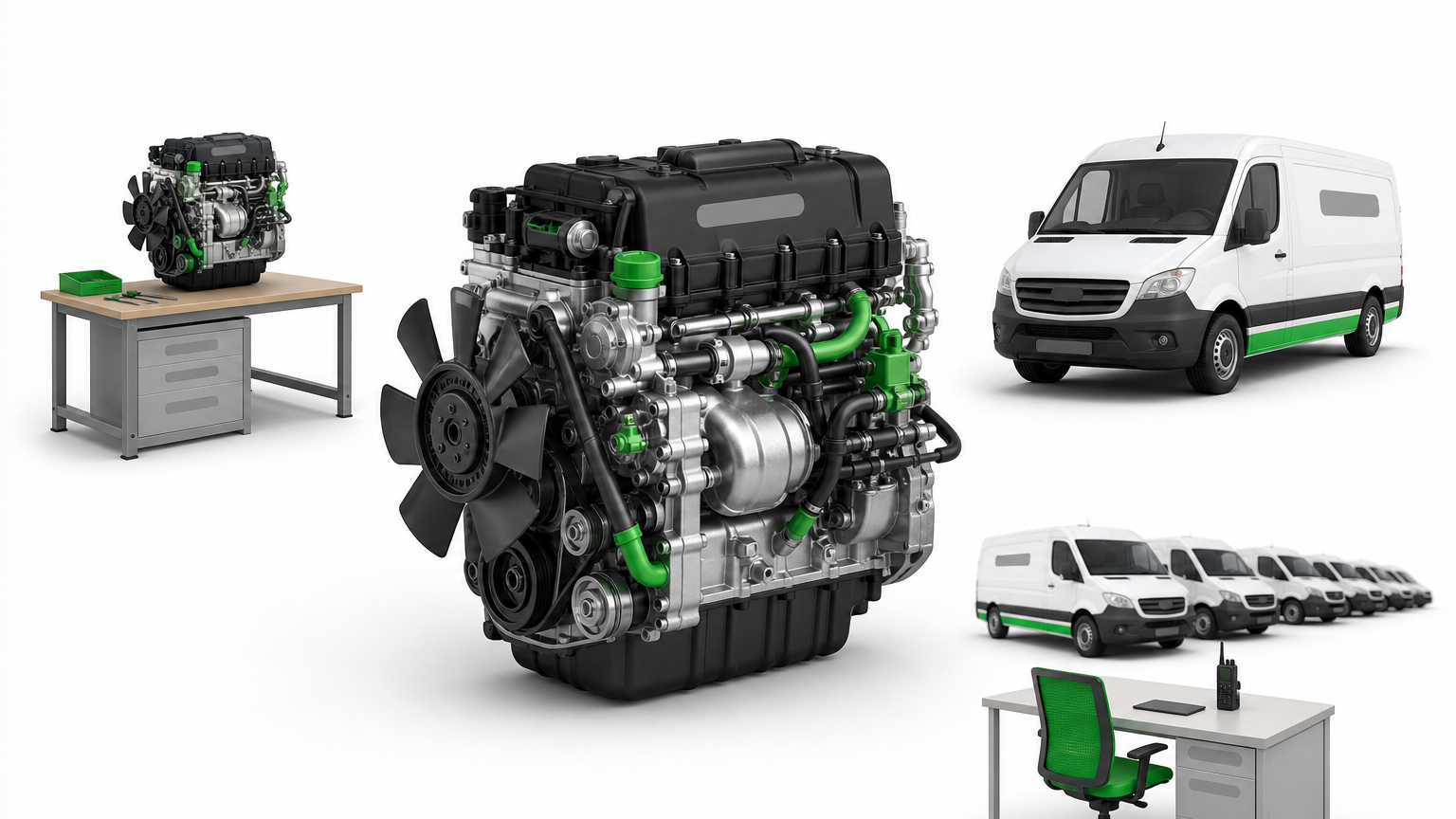
    An engine, a van built around it, and a fleet of vans with a dispatcher desk.

    Generative AI is the engine, an AI agent is a vehicle built around it, and agentic AI is the fleet with a dispatcher.

    So the agentic AI vs AI agents question is about scope, not about which model you license. You can start with one agent, prove it on real data, and add coordination later. Building in layers lets you add autonomy only where your testing shows it is safe.

    Real-world examples of AI agents and agentic AI

    AI agent examples make the split concrete. Across industries the pattern repeats: an agent owns one task, while an agentic system owns an outcome.

    Examples of single AI agents

    Most production AI today is agents. Each has a single trigger, a few tools, and a clear finish line, so you can measure accuracy on a fixed test set before launch. Typical examples:

    A desk with invoices, a ticket tray, and a calendar, each marked with a small flag.

    • A support agent that tags tickets and drafts replies
    • An accounts payable agent that extracts invoice lines and posts them to your ledger
    • A sales agent that qualifies inbound leads and books meetings

    Examples of agentic AI systems

    Agentic AI appears where work crosses systems and the route changes case by case. The table shows one industry at both levels, with the agentic version owning the whole outcome.

    Industry AI agent Agentic AI
    Insurance Extracts data from a claim form Runs a claim from intake to payout recommendation, checks coverage, flags fraud, routes exceptions
    Logistics Predicts a delivery delay Reroutes the shipment, rebooks the carrier, notifies the customer
    Banking Summarizes a KYC document Runs the onboarding review, requests missing documents, escalates edge cases

    The difference between agentic AI vs AI agents is less about intelligence and more about how much of the journey the system owns.

    Start narrow, then connect

    Nothing in the agentic column is exotic. Each row is several agents plus coordination, memory, and escalation rules. The practical path is to deploy one agent first, prove it on real data, then connect it to others.

    Also watch for cosmetic claims. A demo that runs a scripted five-step flow is an agent with a long script. Ask the vendor to show the system recovering from a failed step. If it cannot, it is not choosing its own route.

    How to decide which approach fits your business

    Choosing between AI agents vs agentic AI is a business decision before it is a technical one. Three questions drive it: how predictable the work is, how costly a mistake would be, and whether your systems are ready. Start with the work, not the technology, because the right answer changes from one process to the next inside the same company.

    Match the approach to the work

    Look at the process you want to improve and count the decisions inside it. Fixed steps with a clear finish line point to an agent. Variable routes across several systems point to agentic AI.

    • Choose a single AI agent when the task repeats, inputs look alike, and success is easy to measure. Invoice extraction and ticket tagging fit this.
    • Choose agentic AI when each case needs different steps and the goal is an outcome, such as handling a claim or recovering a delayed shipment.
    • Choose neither yet when the process is undocumented. If your own team cannot describe the steps, software cannot learn them.

    Check your readiness

    Next, test your AI readiness by checking whether your foundations can support autonomy. An agent needs clean access to the right data and a few reliable APIs. An agentic system also needs shared memory, logging, and approval gates, and those take real engineering time to build and test.

    Risk tolerance matters just as much. If an error touches money, health records, or legal exposure, limit what the system can do alone and keep a person at the final checkpoint. Teams in banking and insurance often start with agents that recommend, then let them act only after months of clean results.

    Give a system the least autonomy that solves the problem, then grant more only as your evidence builds.

    Match the engagement model

    Budget shape follows scope. A single agent with a defined task suits a fixed-price project, since you can test it against real examples and know the finish line. An agentic system grows as you add agents, tools, and rules, so a dedicated team usually fits better. Either way, pilot one workflow first. Measure error rate, time saved, and how often a person had to step in, then decide whether the next workflow earns more freedom.

    Common misconceptions, including ChatGPT and agent types

    Three myths come up in almost every scoping call. Each one leads to the wrong purchase or the wrong level of oversight, so it pays to clear them up before the AI agents vs agentic AI discussion goes any further.

    Myth: ChatGPT is agentic AI

    A plain chat session is generative AI. You type a prompt, it returns text, and you decide what happens next. Nothing acts on your systems and nothing pursues a goal after the reply appears.

    The line moves when tools enter the picture. Give a model a browser, your calendar, or code execution plus a task, and it behaves like a single AI agent. Even then it is one agent. It is not a coordinated system with shared memory, escalation rules, and several specialized agents.

    Myth: agentic means no humans

    Agentic describes who chooses the route, not who is accountable. Production systems keep approval gates on anything touching money, records, or legal exposure. Teams that remove people entirely usually put them back after the first costly error.

    Autonomy is a setting you tune per workflow, not a switch you flip for the whole system.

    Myth: the classic agent types are the same as agentic AI

    Textbook AI, such as Russell and Norvig’s Artificial Intelligence: A Modern Approach, sorts agents into five types. These describe how one agent decides, not how many agents work together.

    Type How it decides Example
    Simple reflex Fixed if-then rules on current input Spam filter rule
    Model-based Rules plus a memory of the world Inventory monitor
    Goal-based Picks actions that reach a target Route planner
    Utility-based Weighs trade-offs to maximize a score Dynamic pricing engine
    Learning Improves from feedback Recommendation engine

    A goal-based agent is still one agent. Agentic AI is a system-level property: several agents, any of these types, coordinated toward an outcome. So when someone says "it’s a learning agent, so it’s agentic," ask how many components share the goal and who decides the route. Those two answers settle it.

    Putting the two terms in their place

    The difference comes down to scope. An AI agent completes a defined task, while agentic AI coordinates several agents toward a goal and chooses its own route. Generative AI sits underneath both, creating content but not acting. Once you see that, the AI agents vs agentic AI debate stops being about labels and starts being about how much of an outcome you want a system to own.

    For your own projects, test behavior instead of trusting vendor names. Start with one agent, prove it on real data, and add autonomy only where results justify it. Give a system the least autonomy that solves the problem, and keep human checkpoints wherever money, records, or compliance are at stake.

    If you are weighing agentic AI vs AI agents for a real workflow, our senior engineers can help you size it. You can scope an AI agent pilot with Hatzs Dimensions and get a plan that fits your process and risk level.

  • The Enterprise AI Readiness Gap: 3 Paths to Successful AI Adoption

    The Enterprise AI Readiness Gap: 3 Paths to Successful AI Adoption


    Contents

    1. Introduction
    2. Key Takeaways
    3. What Makes Enterprise AI Readiness Uniquely Challenging
    4. The Scale of the AI Adoption Gap
    5. Three Paths to Close the AI Readiness Gap
    6. Common Failure Modes in Enterprise AI Adoption
    7. How HATZS Approaches the AI Readiness Challenge
    8. Conclusion

    Introduction

    Most enterprises are not failing at AI because the technology is immature. They are failing because they attempt to deploy AI onto infrastructure, workflows, and teams that were never designed to support it. The enterprise AI readiness gap is not a technology problem — it is a strategy and execution problem, and it manifests differently depending on where an organization sits on the maturity curve.

    According to McKinsey’s 2025 State of AI report, while over 72% of organizations have experimented with AI in at least one business function, fewer than 25% have successfully scaled those experiments beyond a single department. The gap between experimentation and enterprise-wide value is where most initiatives stall — and where competitive advantage is decided.

    This article delivers a concrete framework: three deployment paths for closing the AI readiness gap, a decision matrix to help you choose the right one, and the failure modes that derail even well-resourced organizations.


    Key Takeaways

    • Over 72% of organizations have run AI experiments, but fewer than 25% have scaled them successfully
    • The global AI market is growing at 38.1% CAGR, projected to reach $1.8 trillion by 2030
    • Poor data infrastructure is the single most common reason AI pilots fail to reach production
    • Organizations that invest in AI governance frameworks before deployment reduce incident rates by up to 60%
    • The right adoption path depends on your current data maturity, internal capability, and deployment timeline — not on what competitors are doing

    What Makes Enterprise AI Readiness Uniquely Challenging

    AI readiness is not a single capability — it is a composite of data infrastructure quality, organizational change management, governance frameworks, and technical talent. Most readiness assessments focus on only one of these dimensions and miss the others entirely.

    The required conditions for enterprise-grade AI deployment span clean, governed data pipelines; integration architecture that connects AI outputs to business workflows; cross-functional alignment between IT, operations, and business leadership; and observability tooling that makes model behavior auditable. Organizations that are strong in one dimension but weak in others deploy systems that underperform or create operational risk.

    The challenge is compounded by the pace of change. Tooling that was best practice eighteen months ago is being replaced by new orchestration frameworks, foundation model APIs, and deployment standards. Organizations building internal capability must invest in learning infrastructure that can keep pace with the field — not just the current state of it.

    A practical benchmark: if your organization has run more than two AI pilots that did not reach production, the barrier is almost certainly readiness, not technology. Three paths lead forward.


    The Scale of the AI Adoption Gap

    The gap between AI ambition and AI execution is widening at the enterprise level. Global AI spending is on track to exceed $300 billion annually by 2026, with the majority allocated to tools and platforms rather than the organizational change required to use them effectively.

    The pressure shows up most acutely at the data layer. Studies consistently show that data quality and accessibility issues are the primary blockers for 67% of failed AI initiatives — not model performance. Organizations that invest in data infrastructure first consistently outperform peers who start with model selection. A 2025 Gartner survey found that companies with mature data governance practices were 2.5 times more likely to achieve measurable AI ROI within 12 months.

    At the talent layer, the challenge mirrors the broader technology market. Demand for engineers with production-grade AI deployment experience significantly outpaces supply. But the more acute shortage is in AI product managers and business analysts who can translate model outputs into workflow changes — roles that are rarely included in AI hiring plans but are critical to actual value realization.

    The governance gap is equally serious. Enterprises deploying AI without defined risk frameworks, model monitoring, and escalation protocols are accumulating technical and regulatory debt that becomes increasingly expensive to unwind as deployment scales.


    Three Paths to Close the AI Readiness Gap

    No single route works for every organization. The right path depends on your current data maturity, internal capability, deployment timeline, and risk tolerance. The comparison below provides an objective starting point.

    DimensionPath 1: Foundational BuildPath 2: Accelerated PartnershipPath 3: Hybrid Transformation
    Time to first production deployment12–18 months6–10 weeks10–16 weeks
    Estimated Year 1 investment$300K–$600K$100K–$220K$150K–$350K
    Internal capability retainedHighLow without transfer planHigh with structured handoff
    Risk profileLower long-termHigher if vendor-dependentBalanced
    Best-fit organizationWell-resourced, long runwayFast-moving, constrainedMost mid-market and enterprise

    Path 1: Foundational Capability Building

    Foundational capability building is the right long-term investment for organizations whose AI ambition is central to competitive strategy and who have the runway to execute it properly. The practical path does not start with model selection — it starts with a data and governance audit.

    A credible foundational program runs in three phases. First, a cross-functional team conducts a 4–6 week data infrastructure assessment, identifying quality gaps, access bottlenecks, and governance weaknesses. Second, a 3–4 month infrastructure remediation phase establishes clean data pipelines, access controls, and monitoring baselines. Third, the first AI use case is deployed on this stabilized foundation — not before.

    The critical investment is not technology but organizational alignment. Foundational builds fail when AI initiatives are treated as IT projects rather than business transformation programs. Executive sponsorship and defined business outcome metrics must precede the first line of architecture.


    Path 2: Accelerated Partnership

    Accelerated partnership provides immediate access to AI deployment expertise for organizations that cannot afford to wait. A partner team with production-grade experience brings pre-built frameworks, proven architecture patterns, and implementation speed that can compress a 12-month build into 8–10 weeks for well-defined use cases.

    The tradeoff is dependency and knowledge transfer risk. Organizations that engage AI partners without specifying documentation standards, architecture handoffs, and internal team embedding requirements often find themselves unable to maintain, monitor, or modify the systems they have paid to build. Every partnership engagement must include milestone-based knowledge transfer as a contractually accountable deliverable — not a goodwill intention.

    For PE-backed companies, fast-moving scale-ups, and organizations facing competitive pressure with limited internal bandwidth, this path delivers the fastest time to measurable value. The key is selecting a partner that treats knowledge transfer as a product, not an afterthought.


    Path 3: Hybrid Transformation

    The hybrid transformation model is the most practical choice for most enterprises in 2026. External specialists handle readiness assessment, architecture design, and initial deployment. Internal teams embed with those specialists and learn by building. After 3–4 months, the internal team owns operations and iteration while the external partner provides architectural guidance for the next use case.

    This model reduces Year 1 investment by 30–50% compared to a full foundational build. More importantly, it accelerates internal capability by 6–9 months compared to self-directed programs, because engineers and analysts absorb production-grade patterns from practitioners who have solved the same problems across multiple industries. That tacit knowledge transfer is the primary value delivered — the deployed AI system is secondary.

    The hybrid model also handles the senior talent shortage without requiring a permanent high-cost hire. Organizations gain expert judgment during the highest-risk phases — architecture and initial deployment — while building sustainable internal capacity for ongoing operations and iteration.


    Common Failure Modes in Enterprise AI Adoption

    Most enterprise AI initiatives fail at execution, not conception. Four failure modes appear consistently across organizations navigating the readiness gap.

    Failure Mode 1: Starting with the model instead of the data. Organizations that begin AI initiatives by selecting tools and models before auditing their data infrastructure consistently underperform. Models are only as good as the data they operate on. A 2025 Deloitte analysis found that 58% of failed AI projects traced the primary cause to data quality issues that were known before deployment began. Prevention requires a data readiness assessment as the mandatory first milestone.

    Failure Mode 2: Treating AI deployment as an IT project. AI systems that improve business outcomes require business outcome ownership. When AI initiatives live entirely within IT without a business sponsor defining success metrics, they optimize for technical performance rather than business value. A chatbot with high resolution rates but declining customer satisfaction scores is a deployment failure, not a success. Every AI initiative needs a business lead accountable for outcomes.

    Failure Mode 3: Skipping governance until something goes wrong. AI systems operating at scale without defined monitoring, intervention protocols, and audit trails create regulatory and reputational risk that compounds over time. Governance frameworks are consistently deprioritized in favor of deployment speed — until an incident makes the cost of that decision concrete. Governance architecture must precede production deployment, not follow it.

    Failure Mode 4: Measuring inputs instead of outcomes. Organizations that track AI project metrics — models deployed, APIs integrated, hours invested — without measuring business outcome metrics — revenue influenced, cost reduced, decisions improved — cannot demonstrate ROI and lose executive support before value is realized. Success metrics must be defined in business terms before the first deployment begins.


    How HATZS Approaches the AI Readiness Challenge

    HATZS approaches enterprise AI adoption through an integrated readiness-first methodology that addresses data infrastructure, organizational alignment, and governance before a single model is deployed. Our engagement model combines embedded expertise with deliberate internal capability transfer — ensuring that every client team we work with ends the engagement more capable than when it began.

    Our process starts with a structured AI Readiness Assessment: a 3–4 week diagnostic that evaluates data quality, infrastructure architecture, governance maturity, and internal capability across the dimensions that most directly predict deployment success. The output is not a report — it is a prioritized action plan with defined milestones, resource requirements, and risk flags.

    From there, HATZS works with each client to select the deployment path that matches their constraints. Whether through a foundational build, accelerated partnership, or hybrid transformation engagement, our teams bring production-grade patterns from cross-industry deployments and codify those patterns into documentation, runbooks, and training that empower internal teams to own and evolve their AI systems long-term.

    Across recent client engagements, organizations working with HATZS have reduced time-to-first-production-deployment by an average of 12 weeks compared to internally estimated timelines, while simultaneously closing data infrastructure gaps that had previously blocked 2–3 prior AI initiatives.


    Conclusion

    The enterprise AI readiness gap is a solvable problem — but only if it is diagnosed correctly. Organizations that treat AI adoption as a technology procurement decision will continue to fund pilots that never scale. Organizations that treat it as a business transformation initiative, with the data infrastructure, governance, and organizational change requirements that transformation demands, are the ones deploying AI that changes outcomes.

    The decision framework is straightforward. If your organization has an 18-month runway and strategic AI ambition, invest in foundational capability. If you need production deployment within a quarter and have a well-defined use case, engage an experienced partner with a non-negotiable knowledge transfer component. For most organizations, the hybrid transformation model delivers the optimal balance of speed, cost control, and sustainable internal capability.

    Start with one honest question: when your last AI pilot failed to reach production, what was the actual reason? The answer determines your path.

    Ready to assess your organization’s AI readiness and select the right deployment path? HATZS’s advisory team helps technical leaders and business executives understand where they stand and what it takes to move forward. Contact us to schedule an AI Readiness Assessment.


    HATZS is a technology consulting and AI solutions firm helping mid-market and enterprise organizations design, deploy, and scale AI initiatives that deliver measurable business outcomes.


    Frequently Asked Questions

    What is the enterprise AI readiness gap? The AI readiness gap describes the distance between an organization’s intention to deploy AI and its actual capacity to do so successfully at scale. It encompasses data infrastructure quality, governance maturity, internal talent, and organizational alignment. Most enterprises have significant gaps in at least two of these dimensions.

    How long does it take to close an AI readiness gap? It depends on the depth of the gap. Organizations with mature data infrastructure and existing technical capability can move to production deployment in 8–12 weeks with the right external support. Organizations with significant data quality or governance deficits typically require 12–18 months for foundational remediation before reliable production deployment is achievable.

    What is the most common reason AI pilots fail to reach production? Data quality and accessibility issues account for the majority of failed AI transitions from pilot to production. This is followed by lack of business outcome ownership and absence of governance frameworks. Model performance is rarely the primary failure cause.

    Should we build AI capability internally or work with a partner? Neither pure option is optimal for most organizations. Full internal builds take longer than competitive pressures allow. Full outsourcing without knowledge transfer creates dependency that becomes expensive over time. A hybrid model — where external experts lead architecture and initial deployment while internal teams embed and learn — delivers faster deployment and sustainable internal capability simultaneously.

    What governance capabilities are required before deploying AI in production? At minimum: logging of model inputs and outputs, monitoring dashboards with defined alert thresholds, human-in-the-loop intervention mechanisms for high-stakes decisions, rollback protocols, and defined escalation paths for anomalous behavior. These should be designed and validated in staging before any production deployment.

    How do we evaluate an AI consulting partner? Evaluate on three dimensions: documented case studies showing production deployments (not prototypes), a sample architecture document or assessment output demonstrating systems thinking quality, and a clearly specified knowledge transfer methodology with milestone-based handoff criteria. Partners who cannot provide all three should not reach the shortlist.